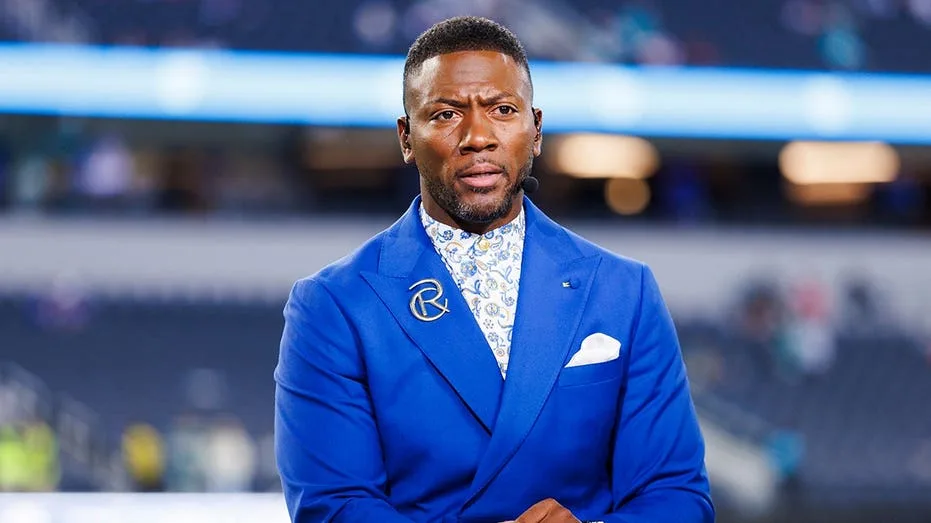
Ryan Clark, a former analyst, has once again publicly accused ESPN of deliberately disclosing news of his termination to a specific sports media outlet with the intent to humiliate him. He made these remarks during a recent appearance on the prominent radio program "The Breakfast Club."
"Everyone else who was laid off was informed on Tuesday. Only one individual was notified on Monday while on set. That was me. That's the key difference," Clark explained to the hosts on Tuesday. He further stated, "It was also intentional. In my view, it was meant to humiliate. By leaking it to that particular publication, you then know if anyone will support you in this decision, it will be them because it involves me."
ESPN officials informed Clark of his termination during a commercial break of the July 22 broadcast of "NFL Live," after which he did not return to the program.
Clark continued, "There are so many reputable sports publications. Whether it's, you know, Sports Illustrated, The New York Times, The Athletic. If this was going to be as significant a story as it became, why not provide it to them? Because they knew who they were giving it to. They knew the small number of people within that building who were aware of it. Then there's the humiliation that you at least intended to accompany my layoff."
"I do feel like it was about that humiliation, and he wanted to save me from that. There was already going to be enough written. It was already going to be enough laughs, enough jokes that I worked that day anyway. So I appreciated him."
This marks another instance of Clark making such an assertion, and it is not the first time listeners of "The Breakfast Club" have heard this narrative.
The day after a news outlet reported the development, one of the radio show's hosts claimed a source informed them that an ESPN executive, Burke Magnus, had leaked the information to a publication to spite Clark. It is plausible that this source was someone who had spoken with Clark, or even Clark himself.
However, the version of events presented by Clark and the radio show's hosts does not align with a comprehensive understanding of the situation. A detailed account from those closely involved reveals how the information became public and why ESPN chose to inform Clark of his termination during a live broadcast.
Let us examine the sequence of events.
Mounting Internal Concerns at ESPN
The story traces back to Super Bowl week in February. Although the game itself aired on a different network, agents, executives, and on-air talent from various broadcasters typically gather in the host city for meetings and negotiations. A significant piece of information that emerged during that week was that Clark’s standing at ESPN had reportedly diminished in the lead-up to the network’s inaugural Super Bowl broadcast in 2027.
Sources indicated that Clark was unlikely to remain part of ESPN’s "Monday Night Countdown," which was slated to serve as the network’s Super Bowl pregame and halftime show. There were also questions raised about whether he would continue to be employed by ESPN at all.
These early indications were not entirely unexpected.
Despite Clark's assertions, he was not universally well-regarded within ESPN. While he had notable advocates, including Stephen A. Smith, ESPN NFL studio executive Seth Markman, and Mina Kimes, he also faced considerable criticism from various detractors.
Complaints concerning Clark included his handling of previous contract negotiations, which involved public videos and frequent updates; controversial remarks about Robert Griffin III regarding his marriage to a white woman; a heated disagreement with Peter Schrager, both on-air and behind the scenes; imprudent comments about Louisiana police; and generating multiple headlines that extended beyond sports coverage.
ESPN typically does not dismiss talent over a single incident. The network generally proceeds with caution when terminating Black talent, seeking to mitigate the risk of unfounded accusations of racism, claims that Clark eventually made regardless.
Therefore, waiting for a broader period of layoffs was deemed a more sensible approach.
These internal discussions and concerns persisted throughout the spring and summer, particularly after ESPN notably excluded Clark from its upcoming Super Bowl plans during the network’s May upfront presentation.
Before July, a news publication had also reported on multiple occasions that Clark’s future with ESPN was uncertain.
The Timeline of the Report and Departure
The narrative then moves to July.
On Friday, July 17, a media contact shared information that ESPN was planning to dismiss Clark the following week, coinciding with anticipated widespread layoffs. This individual was not a formal source; the discussion was private and off the record, not intended for publication, and there were initially no plans to report it.
Two days later, on Monday, others in the industry began inquiring whether the news of layoffs had been heard, specifically who was on the list, and if Clark was among those slated for dismissal. That afternoon, it became known that a colleague at the same publication had also received information indicating ESPN intended to lay off Clark on Tuesday.
Subsequently, information was consolidated and confirmed with two additional sources. While the publication typically refrains from reporting on transactional media news, Clark had become a prominent figure in broader sports discourse due to his commentary on racial and political topics.
It was determined that the story possessed sufficient public interest to warrant immediate reporting.
Around 4 p.m. ET that day, in adherence to standard editorial practice, ESPN’s public relations department was informed of the intention to report Clark’s termination. ESPN PR stated they would respond. Approximately 4:48 p.m., the network replied with a "no comment."
The story was then published, only for it to be discovered that another prominent sports news outlet had released a concise version of the news at approximately the same time.
It was later confirmed that ESPN informed Clark of his termination during a commercial break, precisely around 4:48 p.m. — moments before sending its response to the news publication.
This timeline clearly indicates that ESPN did not collaborate with the publication. No high-ranking individual at the company leaked the information to the publication, nor was there an intent, as Clark suggested, to "humiliate" him.
Assessing the Handling of Clark's Exit
So, why did ESPN manage the situation in this particular manner?
ESPN has communicated to multiple individuals who inquired about the events that management believed the news publication would not withhold the story until after "NFL Live." The network reportedly feared that Clark would learn about his termination from the impending news report.
The executive who informed Clark — and also told him that the news publication was aware of the situation — was Seth Markman, an individual considered one of Clark’s allies. It appears Markman made this decision because he believed it was preferable for Clark to hear the news directly from him.
From a critical perspective, Markman’s handling of the situation was flawed, and it inadvertently contributed to the secondary narrative surrounding Clark’s departure: the angle involving the news publication.
ESPN also bears responsibility for assuming the publication would not hold the story until Clark had been addressed. The act of reaching out to the network for comment itself signaled an intent to wait. Furthermore, the network exacerbated the situation by reportedly alerting another sports news outlet that the initial publication had the story.
Regarding why Clark’s termination was announced a day prior to the broader round of layoffs, the explanation is straightforward: his was the only name significant enough to draw substantial public attention.
Cam Newton was the second most prominent figure among those laid off, with his termination reported by the news publication the following morning.
Despite all the drama, headlines, and accusations, the news publication's involvement did not extend beyond reporting confirmed information.
The publication received information from sources and reported it after seeking comment from ESPN. Every subsequent subplot was a consequence of ESPN’s mishandling of the situation and Clark’s accusations of collusion with his former employers. To prevent similar incidents, ESPN should reconsider its assumptions about media intentions and enhance its protocols for safeguarding sensitive information.
Perhaps unknown to both ESPN management and Clark, the impending news of his departure was relatively common knowledge within and around ESPN circles. Information tends to circulate. And the news publication has historically not required an intentional leak to become aware of internal developments at ESPN.