South Africa Deploys Thousands of Police Amid Deadly Anti-Immigration Protests Spreading Nationwide
Deadly anti-immigration protests in South Africa have prompted a nationwide deployment of thousands of police amid spreading clashes and looting.
World·
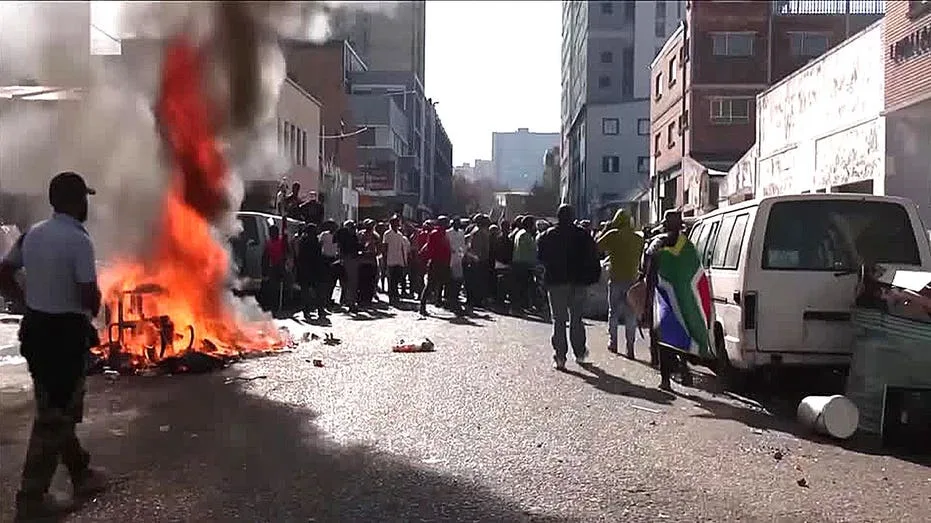
Thousands of law enforcement personnel have been deployed throughout South Africa following the eruption of widespread protests against undocumented immigration. These demonstrations, which began on Tuesday and have involved thousands of participants, quickly escalated into destructive clashes across various urban centers. The unrest intensified as it approached a June 30 deadline, a date established by some organizing groups for the departure of all undocumented foreign nationals.
The marches have primarily attracted thousands of South Africans, many of whom are experiencing poverty or unemployment. These individuals assert that foreign migrants are seizing available jobs by accepting reduced wages and also contribute to elevated crime rates within the nation.
Widespread Unrest and Escalating Violence
The escalating violence and widespread looting across the country have resulted in at least four fatalities. These confrontations represent the most significant migration-related protests to occur in South Africa since a wave of anti-migrant violence swept the nation in 2008.
Even before the Tuesday deadline, thousands of foreign nationals from various African countries had already departed, yet tensions have remained acutely high. Reports indicate that numerous businesses and private properties have suffered vandalism in several affected areas.
Impact on Communities and Migrants
In response to anticipated further aggression, many commercial establishments reportedly closed their doors, and foreign workers opted to remain in their homes. Furthermore, residents in Durban and Johannesburg have claimed that landlords unlawfully evicted foreign tenants in an effort to avert additional disturbances. It has also been noted that approximately 100 Congolese nationals were observed sleeping on the streets of Durban.
Although some demonstrations proceeded peacefully, authorities confirmed making multiple arrests for looting and employing rubber bullets to scatter crowds. In the Soweto township, demonstrators were reported to have plundered informal dwellings belonging to foreign residents. Witnesses in Thembisa, a Johannesburg suburb, described rioters throwing stones at police officers and individuals believed to be migrants, with intermittent gunfire audible. East of Johannesburg, in Benoni, law enforcement units deployed tactical vehicles and discharged firearms after encountering a group of approximately 500 demonstrators.
Government Response and Warnings
A defense ministry representative confirmed in a statement that thousands of police officers are now deployed across the country, and the military has been placed on standby. Lieutenant General Tebello Mosikili issued a stern warning:
"To those who intend to break the law tomorrow, our message is simple: do not test the resolve of the State."
Organizers' Demands and National Context
The "March and March" organization, identified as a leading force behind the recent unrest, commented on the violence, asserting that it cannot be held accountable for spontaneous incidents that occur during demonstrations. Jacinta Ngobese, the group's leader, stated approximately two weeks prior:
"Unfortunately, we can't be in every single community telling them ... how to behave."
Ngobese indicated that the group intends to conduct weekly marches until their objectives are achieved, notwithstanding the government's rejection of their imposed deadline and its stance that only official authorities are empowered to enforce immigration legislation. Ngobese further articulated their demands, stating:
"For the next six months, we are asking for our national resources to be used to take the illegal immigrants out of this country. From building to building -- they must go."
Even with a significant national unemployment rate, South Africa maintains its position as Africa's largest economy, which continues to attract migrants. The country's immigrant population is estimated to be approximately 3 million individuals, constituting about 4% of the total populace.
Related Stories
Guinea Landfill Collapse Kills Dozens, Triggers Search for Survivors Amid Prior Warnings
At least 30 people died when a massive landfill collapsed onto homes in Conakry, Guinea, on Sunday. The disaster, exacerbated by heavy rains, trapped many and destroyed several residences, prompting an urgent search for
Aug 23
Deepening Oil Crisis: Production Disruptions in Persian Gulf May Outlast Hormuz Tensions
As attention focuses on the Strait of Hormuz, experts caution that the deeper oil crisis involves restoring millions of barrels of Persian Gulf production. This "upstream problem" of restarting wells could persist long
Aug 23

Woman Convicted of Fraud After Posing as Child and Living with Brazilian Foster Family
Amanda Maria Souza de Oliveira, 37, was convicted in Brazil for fraud and false identity. She lived with a foster family for 14 months, pretending to be a child, claiming she fled abuse. Her lawyer stated she used this
Aug 23
Liberia Receives First U.S. Deportation Flight Under New Agreement, Welcoming Latin American Nationals
Liberia has welcomed its first group of deportees from the U.S., including individuals from Venezuela, Cuba, and Colombia. This marks the start of an agreement to host up to 1,200 foreign nationals, many seeking
Aug 21